Gathering in Greece: Dream Vacation Ruined by SDIA
By Hamida Thomas
Sabrina Castillo (SD Nederland) and Ramsey Oren (SD Canada), working together on project support.
Some people question why SDIA pays the travel costs of some of the delegates, Board members and Staff to international meetings—such as the intense meetings we just held alongside the Zone 4 Gathering in Aghi Apostoli, Greece. Some even question the need for such meetings: “I'm not going to give my money to any organisation that pays for people to have expensive holidays!”
The idea that SDIA is paying for expensive holidays is a myth, but the need to come together as an association to work through complex issues around international development is very much a reality.
Actually, most delegates and SDIA Board members paid their own way to attend the meetings. Only a few needed assistance from SDIA. Members came from Spain, Portugal, Britain, Canada, India, Indonesia, Ireland, France, Netherlands, Norway, Austria, Germany, Japan, RD Congo and Sweden. Deeper commitments were built for members to work together for lasting improvements to the well-being of the world's populations that are being left behind.
The representatives from eighteen SD Nationals and two projects, not to mention the SDIA Board and Staff came to Greece were indeed disappointed when our dreams of visiting the Acropolis, Delphi, or Agamemnon's ancient palace among other tourist sites, were ‘ruined’ by our commitment to working together to contribute to meaningful change in communities urgently needing to address famine, disease, natural disasters, inequality and injustice of all kinds. It was a great meeting, but most of us never left the conference centre. Our schedule was packed.
What we did
The meeting started with an open session of SD national delegates discussing the challenges and successes they face. There were a number of themes that concerned the SD nationals, including: communicating the significance of SD work; recruiting board members who would be willing to invest the needed volunteer hours; creating understanding and a sense of the importance of Susila Dharma among Subud national and zonal committees; explaining SD to those outside of Subud and projecting a positive image; and harmonizing our granting efforts so that we work more effectively as a network to co-support and strengthen projects. We broke into groups and each group worked on solutions to these challenges.
Thanks to the presence of Lailah Armstrong, we had an informative presentation on the International Child Development Programme (ICDP), long supported by the SD Network. There were many questions about the ICDP's structure, work and sustainability. Daniela Dinis made a presentation on the needs of the Roda Viva community project in Portugal. It was agreed that we would try to come up with $7,000 to $10,000 from within the SD network to help maintain Roda Viva's ICDP programme that had seen its government-funding cut.
The Democratic Republic of Congo (DRC) is one of the few countries that have lost ground in terms of human development indicators over the past decade, with higher levels of disease, malnutrition, and child and maternal mortality. Much work was done to improved understanding of the local context and reach agreement on a set of common responses to needs by the SD DRC Chairman, Dianteza Dimpiokia, and the SD Nationals who support various health, education and livelihood projects in the DRC. We also benefited from the presence of Purnama, Chairman of SD Indonesia, and Lajpat Rao, Chairman of SD India, who brought fresh information about the state of SD projects in their two countries. SD Nationals need this type of information.
Sabrina Castillo, Ichiro Nakamura (Subud Japan), Dianteza Dimpiokia (SD DRCongo), Purnama Widjajakusumah (SD Indonesia) and Teena Gill (SD Australia).
Ichiro Nakamura (SD Japan) delivered a presentation on the devastation experienced by Japanese communities that were affected by the earthquake and resulting tsunami and the response from local Subud members. Rasjidah Flores (SDIA Board member) and Teena Gill (SD Australia Chairperson) and others offered to help SD Japan develop a camp to help children from the affected area recover from the trauma of the disaster.
Three candidates stood for the SDIA Board and were elected at the AGM. After the election, the needs of SDIA were discussed in depth and the members asked the new Directors many questions directly. We welcome new Board members, Livingston Armytage (Australia), Hesther Bate (France) and we also welcome back Lawrence Fryer (Germany). In addition, we extend many thanks to outgoing board members Sharifin Gardiner and Mardijah Simpson for their years of service.
A highlight of the gathering was Kumari Beck (chairperson) and Romina, Hesther and Solen’s presentation to the Zone 4 Council on SDIA. Members from Eastern Europe now understand better what SDIA does and how it can support Subud members who wish to get involved through project support, volunteering, professional expertise, and participating in events linked to the United Nations.
Finally, as many governments put in place new regulations for funds going overseas, there was considerable work done on developing common tools and approaches. The network needs to ensure that the SD Network has the capacity to support strong, well-run projects and to be accountability for use of donors’ funds. Among other things, it became clear that some want more information on 'due diligence'; that we need a common grant request procedure; and that we need to make significant changes to the SDIA website.
While we cannot describe all that was accomplished here, we left feeling exhausted but satisfied with the work we had done and with the new understanding we had gained…and yes, a little disappointed that we had seen practically nothing of the marvelous, beautiful, historic and charming country of Greece.
Participants’ Reflections
Purnama Widjajakusumah, SD Indonesia Chairman
This was my first time at an SDIA AGM and also my first time travelling to Europe, so I won’t forget this very good experience. It was a wonderful gathering especially among the SD Nationals. An unforgettable experience for me was sharing the same topic between people from many countries with different cultures and languages. I found that this networking is very useful for SD Nationals to be able to carry out their responsibilities. Events like this provide support for SD Nationals on communications and information that we need to share, especially for SD Nationals in developing countries such as Indonesia.
Ramsey Oren, SD Canada Chairman
The overwhelming feeling I had while attending the AGM was that I was part of a professional team. Pencils were sharpened and minds were focused on the tasks at hand. There were no star players—only dedicated collaborators in the grand effort to reduce suffering in the world. I saw a great dedication from many of those attending in terms of time away from their professional and family responsibilities in order to be of service to SD projects. There was a pervasive feeling of caring for each other evidenced by the constant delivery of glasses of water to replenish us on the very hot days we experienced in Greece. I was grateful to learn of the very helpful network I belong to as part of SDIA and was able to make strong connections with other SD Nationals. The AGM primarily left me with the awareness that our greatest strength is our connectivity with each other through SDIA and collaboration with other SD Nationals on projects and organizationally, such as when we pool our resources across our national borders. I felt a significant benefit from sharing our experiences on projects and the challenges of working as a Subud organization. The AGM reinforced the image of SDIA as a strong, vibrant and forward-moving organization. I thank all of you at SDIA for your magnificent efforts.
Raimund Gaisbauer, Contact person for Susila Dharma Austria
For me, it was a very fruitful to attend a SDIA meeting for the first time. I was very impressed by the great number of projects all over the world, by the engagement of those involved and by the professionalism that is being carried out. To me, what I have witnessed is putting our latihan into practice at its best. Personally, I also benefitted for my work in project development being reminded to be more conscious of the Guidance of Almighty God.
Dianteza Dimpiokia and Purnama Widjajakusumah.
Dianteza Dimpiokia, SD Democratic Republic of Congo Chairman
What struck me the most was the sense of community in the work. Meeting other brothers and sisters engaged in the work of Susila Dharma around the world was very edifying and reinforced our commitment to this common effort. I realised that our work is one, and that we are all trying to bring our own contribution, whether we are from a developed or developing country, woman or man. Each time a participant spoke about his or her work, I found myself close to what s/he does in his/her country or community. This created in me a feeling of communion with the whole network throughout the world. This physical contact reinforced in me the reality of networking which is so important for the continuity of the work and understanding between us. The brief presence of the brother from Japan and the message of fraternity from all the SDIA AGM participants impressed me!
I really appreciated the act of sharing and making better known the work and mission of Susila Dharma within the Subud community. Beyond Susila Dharma, the parallel meeting of the Zone 4 Council was also an enriching experience, and the sharing and informal exchanges with brothers and sisters from different backgrounds was marvellous – we experienced brotherhood beyond our cultures! And what can I say about those days, which were longer than the nights, unknown in our country...?
Teena Gill, SD Australia Chairperson
It was extremely valuable for me to have members of the SDIA board and office, and also SD nationals working together towards the same goal. We strive for the betterment of humanity through our SDIA projects and national organizations and we need to build our SD energy on a local level to achieve this. Over the days I gained a deeper sense of the work SDIA does, the role of the board and the office and what it means to be a member of SDIA… I started to understand SD Australia's purpose/identity! This is the vehicle to move SD Australia forward to be bigger and better than they have been as an SD national in the past. I found the focus on building a better relationship between Subud and Susila Dharma to be extremely powerful. Altogether, I walked away feeling more confident and also blessed to be part of the SDIA Network. Later, I was able to make a presentation for the first time to the Subud Australia Council and Subud community in Melbourne and talk about the past contributions of SD Australia, how other SD Nationals work within the network, the role of SDIA office and board and how each SD national is unique. I was able to bring a better understanding of what SD Australia is a part of and who we are today, which gives us an ability to work on a plan for the future.
Participants at SDIA'S Annual General Meeting in Greece, Summer 2011.
Session on Getting Involved!
A well-attended workshop on getting involved in Susila Dharma brought together a small panel with varying experience. Solen Lees (SDIA staff) kicked off the meeting by explaining SDIA’s consultative status with the United Nations and why it is important for SDIA to participate in UN events, as well as to forward the aims of the UN in our work in the field. She also outlined SDIA’s new, more focused, strategy, which aims to maximise the impact of attendance at meetings, and, before giving the floor to Sharifin Gardiner, she provided information about how to become a representative for SDIA.
Sharifin is getting together a small delegation of Subud members to attend the World Summit in Rio next year (2012, known as Rio + 20), and he invited people to apply. He explained the importance of this initiative in the framework of the dire state of the global environment, underlining the idea that this issue cuts across all others, impacting the ability to attain rights and reach development goals. There are several meetings leading up to the Rio+20 conference aimed at maximising NGO participation, including a conference in Bonn this September that he and Romina Vianden-Prudent (SD Germany) will be attending.
Hesther Bate, who is a member of the GetInvolved! team and a UN representative, gave her personal perspective on attending a UN meeting in Geneva on gender equality. This experience helped her to understand project realities better, and as a result she was able to relate what she learnt on the issue of women’s rights to her later experience as a volunteer in Moldova.
We next moved on to volunteering in the wider sense. Solen gave a brief history of the GetInvolved! initiative and outlined what SDIA has done to facilitate individual volunteering, including putting suitable volunteers in touch with projects willing to host them.
Rasjidah Flores talks about a Human Force Volunteer Camp.
Rasjidah Flores, SDIA director and member of the GetInvolved! team, went on to give a comprehensive presentation of the Human Force Volunteer camps, which was holding the third camp in Indonesia at the time of the meeting. She outlined the different ways SD members and Subud members could participate—by volunteering, hosting the camp or donating in order to facilitate volunteers’ attendance. At the end of the meeting, an SD National offered a possible venue for next year’s camp!
Next there was a slide-show presentation of the Moldova English Summer School with comments from Hesther and Solen who volunteered at the project (see article). Unfortunately, Anoushka Zotieva, the organiser, had been unable to secure a visa and was therefore unable to give us her insights. Although not quite an adequate substitute, the pictures told the story eloquently.
The final panellist was Teena Gill, SD Australia National chair, who outlined exciting developments in SD Australia’s proposed partnership with Austraining to set up volunteer placements in SD projects. The Australian government owns Austraining and the volunteers recruited have their costs covered as part of one of the Austraining programmes that send both skilled and youth volunteers to projects in developing countries. This initiative is in its infancy and SD Australia has first to prove its capacity to organise volunteer placement in SD projects. However, with Teena’s drive and enthusiasm, expert help from Rasjidah, who is a volunteering professional, and the support of SDIA, this could be something to watch.
Volunteering
English Summer Camp in Budesti, Moldova
Children work hard to improve their English skills.
The first English Language Summer Camp for teenagers from low-income families was supported by SD France, SD Germany, SD Norway, GHFP, SD and SDIA. In a country where many children are exposed to a high risk of poverty and/or the decline of family structures, the community of Budesti, a small town just outside the Moldovan capital Chisinau, is no exception.
In order to guarantee the economic survival of their families, many fathers and mothers work abroad and some families are barely able to adequately support their children. Depression, unemployment, alcoholism and violence often increased family and social pressures on children and youngsters from the community. Moreover, in Soviet times people came to expect the state to take responsibility for much of their education, employment and human development. This led to a serious underdevelopment of their motivational and self-educating skills. Although this mentality is gradually disappearing, it is still possible to see its legacy throughout the country.
The current dynamics of the country’s economy indicate a strong need for qualified specialists able to speak foreign languages. Despite this situation, many children in the Budesti community undervalue the importance of learning English. It was in this context that Anoushka Evghenia Zotieva, a Subud member in Moldova, decided to organize the first English Summer School for local children between the ages of 11 and 14 years old to improve the language skills of the children and their teachers, create a space for the exchange of pedagogical ideas, arouse curiosity in children about different cultures, and motivate them to continue learning English in the future.
Hesther Bate, one of the volunteers from France, writes:
For seven intensive days Solen Lees, Kim Joseph from New York, and I worked alongside 3 teachers from the local community, supported by 3 local volunteers. We played, sang, and ran around having fun, a lot of the time in English: we looked at healthy food, keeping the local community clean, and compared the cultures, ancient and modern, of Moldova and the West (I compared the similarity of Celtic art with their own ancient designs, which we examined in the museum). They also made their own fairy tales, based on an archetypal pattern, which was great fun. In searching for the Golden the Horse, the oldest group had the Prince playing Russian Roulette in a Casino with Johnny Depp!
Each day 31 children and accompanying staff were given two substantial snacks and lunch, and had excursions to local museums, a small farm, and the cinema. The day we looked at the environment, we made splendid 'Keep our Community Clean' posters, and actively cleaned up in the park and around the buildings in the centre of the village. Healthy food produced a small cooking lesson, and more posters, this time for the Centre. Seeing their work being shown in the community naturally boosted the youngsters' self-esteem.
![]()
Creative work helps children improve their English skills.
Unexpected things impressed me, all to do with respect. As I don't eat meat, I offered my ham sandwich to the children opposite me, who had finished theirs: there was a silence, as each one assessed the situation. It was clear that they all wanted the extra, but they encouraged a boy who had broken his arm to take my sandwich. Also, in the 'cooking' session, my group prepared banana/lemon/mint sandwiches. They treated the food in a respectful manner, and made sure everyone had a turn at making, and that the food was equally shared with us teachers too.
At the end of the project both the children and local teachers participated in an evaluation exercise. Although areas that needed improvement were identified, it was agreed that the project was an overall success and had accomplished its goals. It was decided to proceed with the organization of a second camp in 2012.
Human Force Volunteer Camp, Cipanas Indonesia
The importance of dialogue!
Erica Sapir, founder of Puppeteers without Borders project (France) attended the third Human Force Camp as a volunteer.
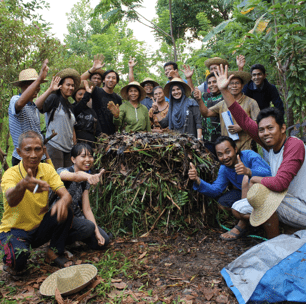
In general I can say that it has been a great success. There were some 14 volunteers: from Australia, New York, India, Colombia, Indonesia, France plus Marmita, who works for YUM in Jakarta, and Hunter, a young American boy who came from the international school in Jakarta. There is now a loving link (through Facebook!) between all participants.
The work at the YUM farm has been significantly helped, as well as the work done in the renovations of the buildings and kitchen. The team of the community center (Samsul and "the three angels" as the three social workers were called), as well as the librarian, all helped and were enthusiastic partners. In the afternoons, the approximately 60 kids who come daily enjoyed such a variety of workshops and enough attention to make an American’s suburban kid envious!
On a more personal note, the puppetry workshops that I delivered went extremely well. Almost every day I would teach the kids a different technique, but, as their English is non-existent and their age quite young, I couldn’t really work with them on a scenario, or organize a performance with more than just a simple dialogue between them.
I also did a puppetry workshop with the volunteers, and two workshops with the Indonesian YUM Cipanas team. I had brought with me a lovely book, edited by Amnesty International, about Human Rights explained to children, with illustrations by 30 famous illustrators. So once we made puppets in two or three techniques, in small groups we worked on an article of their choice, and they prepared short scenes using the article as a basis.
![]()
Erica Sapir and three "angels".
This resulted in a series of short performances, which were presented to the kids during the last, festive evening. Of course the best was the performance of the YUM team, which was done in Indonesian (the other performances needed translation from English, which took away the dynamism of the "drama"), and the children were spellbound and so attentive.
It was for me very touching to witness the dedication of the YUM team to this new medium and their enthusiasm for it. They all seemed determined to adopt puppetry as some ongoing activity, which they will continue to use in the future.
Famine in the Horn of Africa
(Map © National Public Radio, 2011)
SDIA, on behalf of itself and WSA, will be making a donation from its Emergency funds towards famine relief in the Horn of Africa. Due to the fact that SDIA does not have any immediate contacts in the region, we are encouraging readers who want to donate to famine relief to do so through their SD National organisation or talk to the SD National organisation about which charities have a capacity to deliver appropriate humanitarian relief in the region.
For donors in Canada, the Canadian government is matching all donations from individuals from July 6-September 16th, so SD Canada is encouraging its members to donate through Oxfam Canada or Oxfam Quebec.
SD France is sending member donations via UNICEF.
Projects
Prestigious recognition for YUM!
The Clinton Global Initiative letter to YUM July 26, 2011:
On behalf of President Clinton and the Clinton Global Initiative (CGI), I am pleased to formally invite you to join the Clinton Global Initiative. Membership includes one invitation to attend the 2011 Annual Meeting, September 19th – 22nd in New York City.
CGI was created by President Clinton in 2005 in an effort to translate ideas into action. Our Annual Meeting brings together heads of state, government and business leaders, scholars, and NGO directors. Participants analyze pressing global challenges, discuss the most effective solutions, and build lasting partnerships that enable them to create positive social change.
You can read more about the Clinton Global Initiative here.
The International Division of the Japanese National Council of Social Welfare, which has been supporting YUM for various activities over the years, letter to YUM letter August 9, 2011:
Your sincere work on the Welfare Support Program for Sumatran Earthquake & Tsunami Disaster was so impressive, and we would like to invite you to Japan and have a short presentation on the occasion of the 16th Tri-lateral Conference of Non-Governmental Social Welfare Organizations which will be held from October 19 (Wednesday) to 21 (Friday), 2011 at LOFOS Shonan, a training centre of JNCSW in Hayama, Kanagawa.
About 50 delegates from Korea, Taiwan and Japan will participate in this conference, and it will be a good opportunity to share your experience about projects in Aceh with our Asian friends. As it is a year of disaster for many Asian countries, your presentation will be stimulating for all. Representatives from Thailand and Sri Lanka will be invited to give presentation, too. Also, on this special occasion, we are planning to have a presentation ceremony of a letter of appreciation from JNCSW to you.
Congratulations to YUM!
You can read YUM’s latest Newsletter here.
During the June meetings in Rungan Sari Kalimantan, YUM signed an agreement with SD Germany for 3 years of government funding for an agricultural project in Kalimantan. SD Germany representatives Romina Vianden-Prudent and Lawrence Fryer (right) and Olvia Resksodipoetro, YUM chair (6th from right). Daniella Bustillo (4th from left) will be the Project Leader.
Yayasan Tambuhak Sinta (YTS)
You can read the latest Newsletter Kabar Itah here.
From the Office
Another way to Contribute to SDIA
Help increase SDIA’s visibility on Google™ and other search engines by including a link to SDIA’s website (http://susiladharma.org) on your web site.
Receive the Susila Dharma eNews by email !
Sign up to receive the Susila Dharma Network eNews in French, Spanish or English by email.